The IQ Test: Can We Measure Intelligence?
Five friends, Adam, Beth, Chloe, Daniel and Eva, are standing in a line.
· Adam is somewhere to the left of Beth.
· Chloe is immediately to the right of Daniel.
· Eva is not at either end of the line.
· Beth is not next to Eva.
Which of the following must be true?
A) Adam stands at one end of the line B) Daniel stands to the left of Beth C) Chloe is not at either end of the line D) Eva stands between Adam and Beth E) Beth stands immediately to the right of Chloe
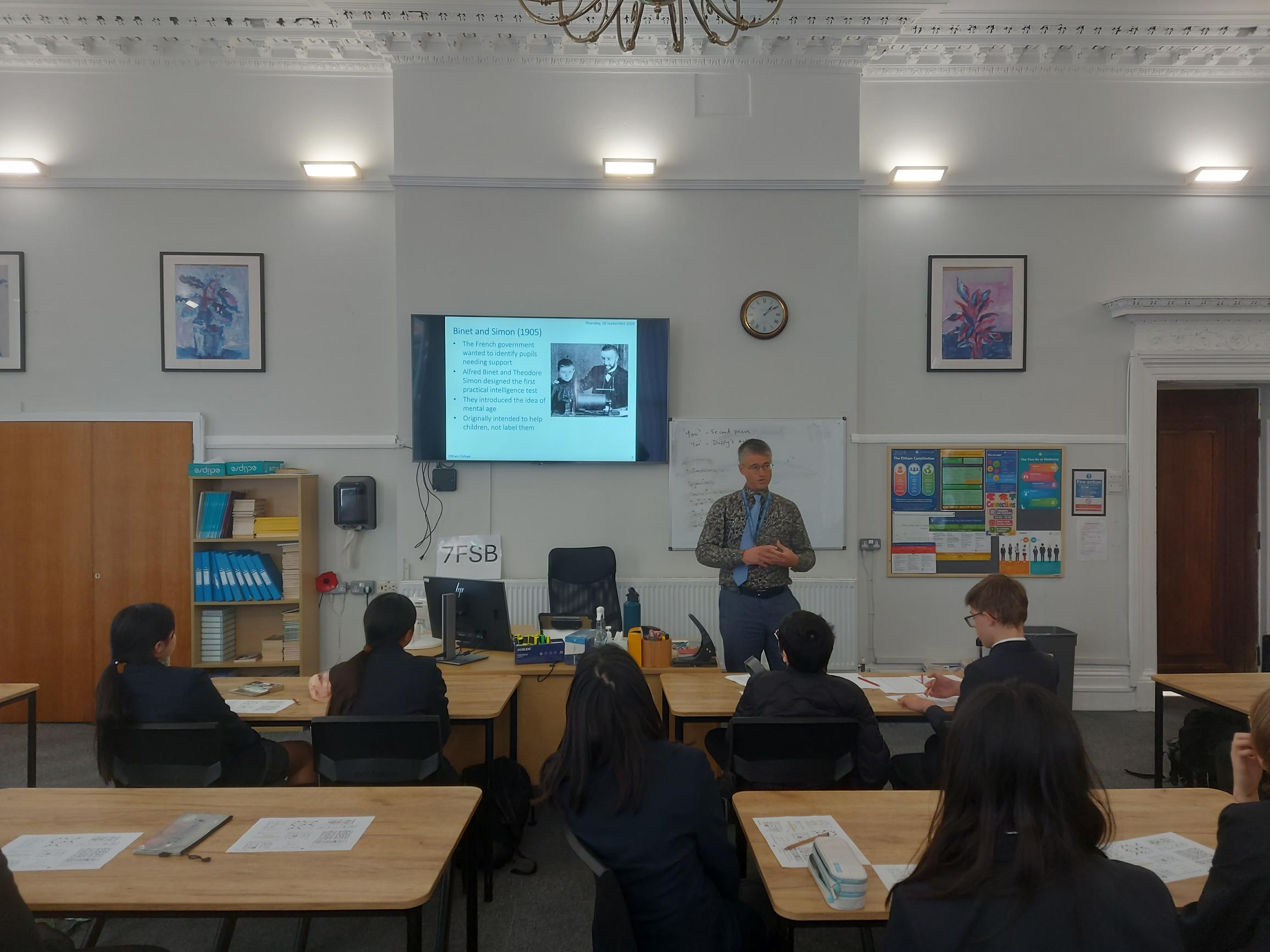
What can we learn from asking and answering this kind of question? What, if anything, does it tell us about the inner workings of your brain? In the first meeting of the Year 8 Academic Scholars, the students worked through some tricky conundrums like this, pondered the meaning of intelligence, the history behind the calculation of IQ and whether putting a number on intelligence is, in any way, meaningful.
In 1905, French psychologist Alfred Binet and psychiatrist Théodore Simon designed the first practical intelligence test, one that the French government hoped would help identify pupils that were struggling and then give them support. The Binet-Simon Intelligence Test involved value judgements about the sorts of things that a student of any age should be capable of. An average 3-year-old, for instance, was expected to be able to point to their nose, eyes and mouth upon request; a 9-year-old, the scientists decided, should be able to recite the days of the week; and a 12-year-old, they felt, should be able to hear and then repeat back a sequence of five digits. Using questions like these, it was possible to come up with a student’s “mental age”.
German psychologist William Stern then suggested using “mental age” to calculate an intelligence quotient or IQ. The maths was simply to divide a student’s “mental age” by their chronological age and multiply by 100. An IQ of 100 would therefore indicate a person was operating at the expected level for their age.
Since then, many different kinds of IQ-like test have been devised to help teachers and employers identify strengths in their students or employees. In the lunchtime session, run by Biology teacher and Assistant Head of Scholarship Henry Nicholls, the scholars saw examples of many different tests, including the notoriously tricky UCAT test that prospective doctors must take at the end of Year 12. The students then discussed the strengths and weaknesses of this kind of assessment.
In case you were wondering, the answer is C) Chloe is not at either end of the line.