What’s It Like to Be a Bat?
Thomas Nagel’s 1974 paper posed the question above and was part of an ongoing exploration into the nature and causes of consciousness. Early iterations of this debate often revolved around challenging Descartes’ dualist view of the physical body and the immaterial soul or spirit, with the materialist (or physicalist) champion Daniel Dennett picking up the baton from Gilbert Ryle.
In more recent times, however, a proliferation of different views has emerged, redefining and reframing the debate. Sir Roger Penrose sees consciousness as the product of quantum activity in the microtubules of the brain. Panpsychists like Philip Goff have revived an ancient idea: that all matter, even at its most basic level, contains elements of consciousness. Giulio Tononi subscribes to the idea of Integrated Information Theory, whilst Anil Seth argues that our brains are constantly re-evaluating what our senses receive, based on previous experiences and best-guess predictions. David Chalmers may feel that none of the above has solved his famous “hard Problem” of consciousness. And where does AI fit into all this? (Chalmers has his own thoughts in his recent book Reality+.)
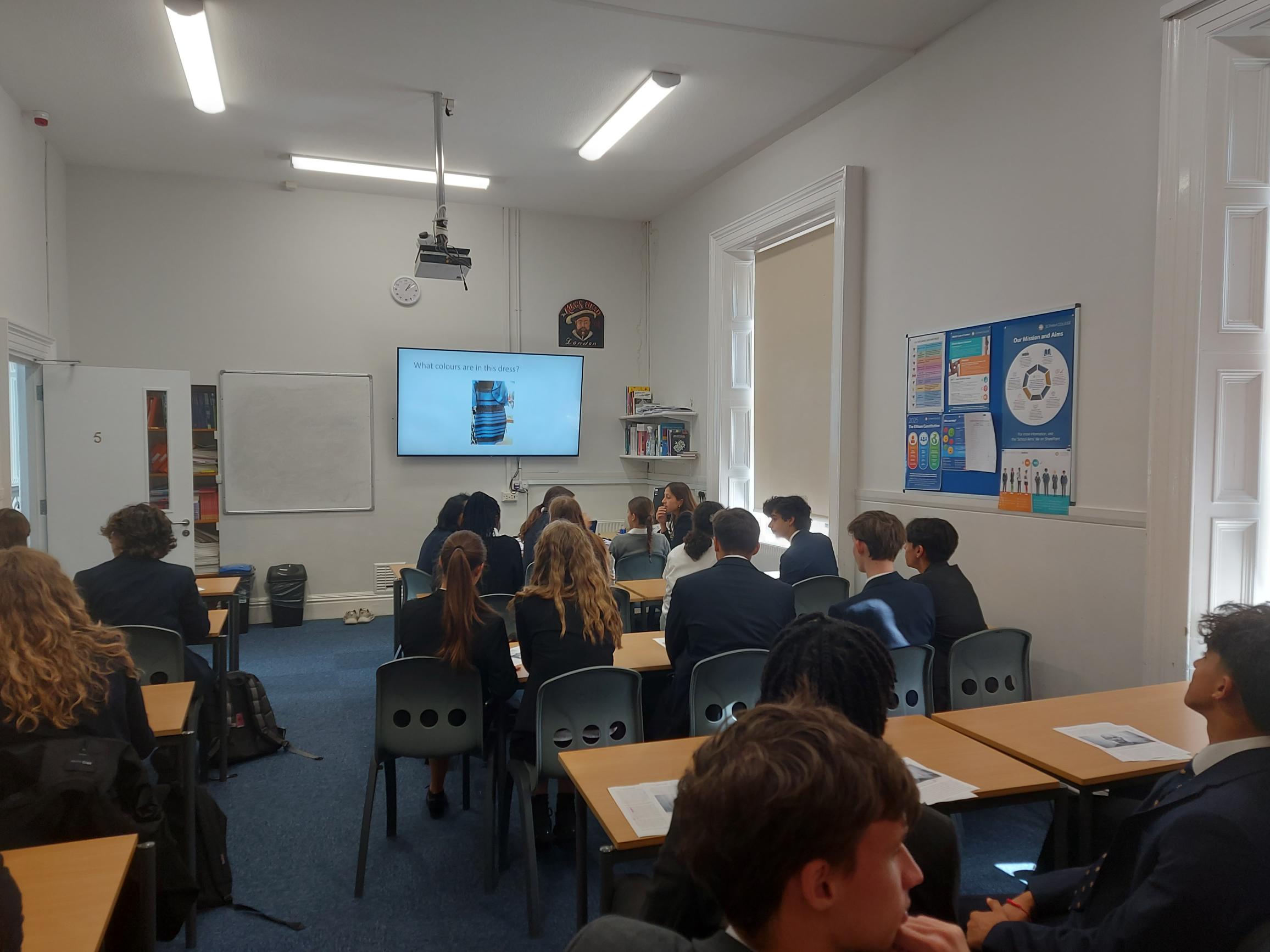
These are some of the ideas being explored by members of the Lower Sixth Symposium in their lunchtime meetings. This group, open to all Sixth Formers, seeks to consider significant topics over a period of several weeks, touching on a wide variety of different disciplines.
As for the bat, Nagel suggests that if we can imagine what it is like to be one, then the bat has consciousness; furthermore, this could serve as a test for whether any number of things may have consciousness. What’s it like to be a plant? Or a table?