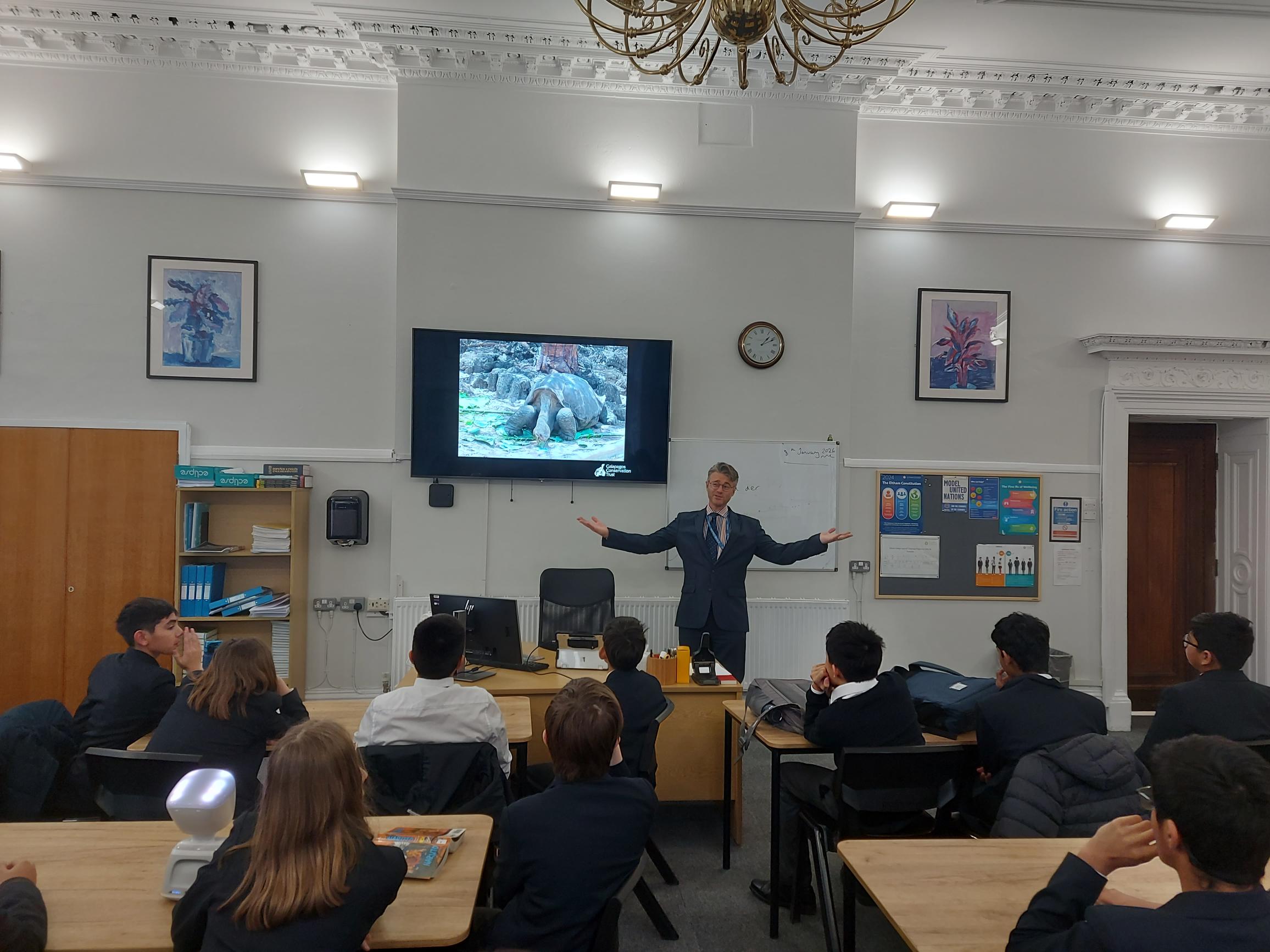
Year 7 Scholars: Lonesome George of the Galapagos
Does it matter if animal species die out? This was an essay question posed by Mr Cavendish to Year 7 scholars just before a lunchtime talk by Dr Nicholls on the life and afterlife of the Galapagos giant tortoise and embodiment of extinction, Lonesome George.
When the first humans reached the Galapagos in the 16th century, they found inhospitable volcanic islands overrun by giant tortoises. Biologists think there were at least 15 different lineages of tortoise in the Galapagos, undergoing divergence in the isolation provided by different volcanoes and islands. Over the next few centuries, these populations – adding up to maybe 200,000 individuals in total – were decimated by whalers and sailors in search of food.
This was the case for the giant tortoises of Pinta, a small island in the north of the archipelago. The last few individuals were assumed to have been collected in 1905 by scientists from the California Academy of Sciences. Yet, against all the odds, one Pinta tortoise survived. He became known as Lonesome George, a conservation icon and the embodiment of extinction. Dr Nicholls, biology teacher and author of Lonesome George: The Life and Loves of a Conservation Icon, introduced the students to the Galapagos and Lonesome George’s story.
When Lonesome George finally died in 2012, the Pinta tortoise vanished forever. But this special animal has had an afterlife, his taxidermy touring the United States before returning to a museum in the Galapagos, where he continues to draw the crowds.