Is the Giant Panda An Evolutionary Failure?
Reporting by Evelyn (Year 8)
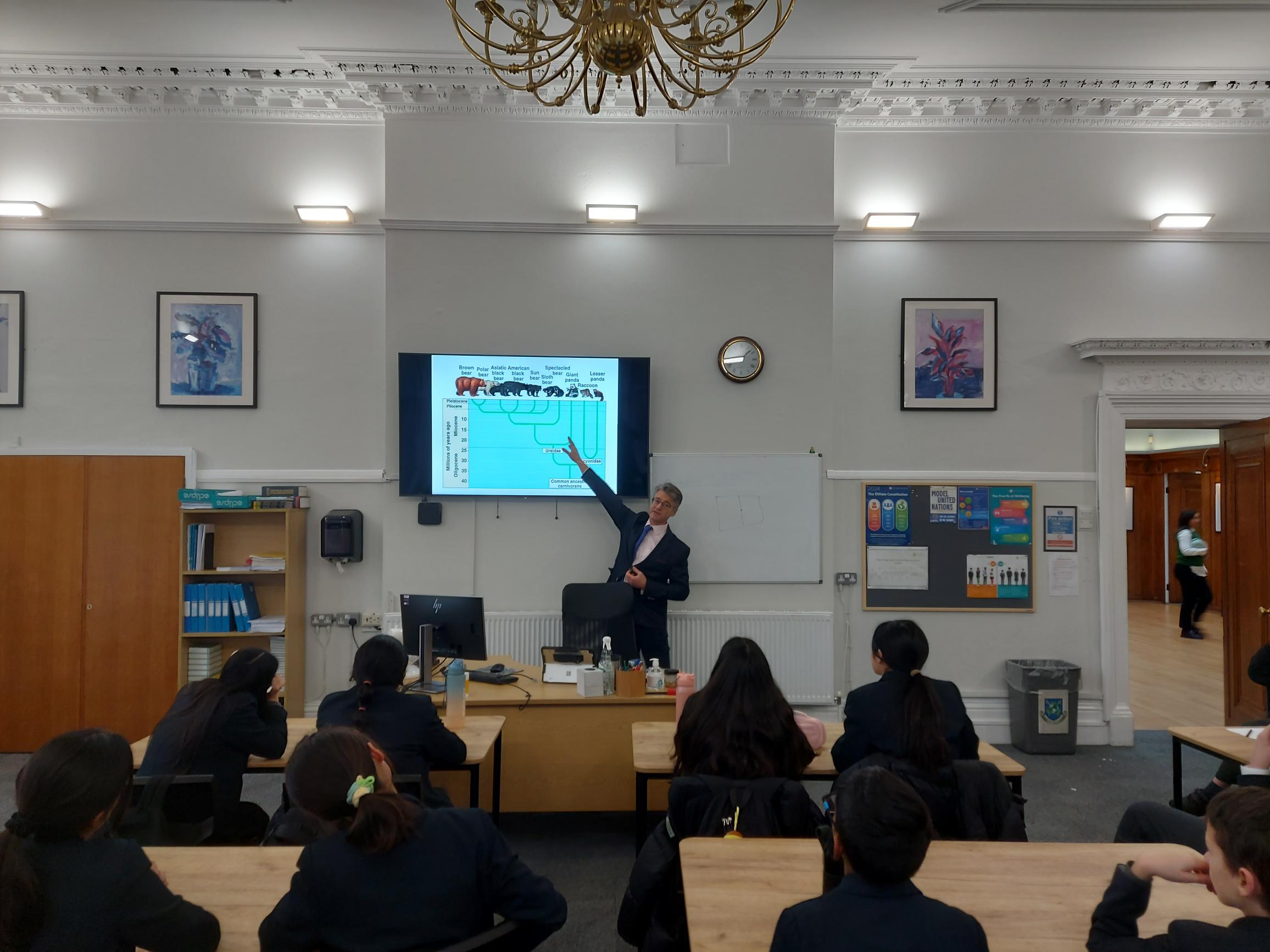
At the first Year 8 Academic Scholars’ meeting of the year, Biology teacher Dr Nicholls began with an interesting question: is the giant panda an evolutionary failure?
In 2009, naturalist and broadcaster Chris Packham argued that giant pandas “should be allowed to die out”. His justification was that the giant panda is “not a strong species” and that the millions of pounds that are poured into panda conservation would be much better spent on other, less charismatic species. Many of the students in the room felt instinctively that Packham’s position had to be wrong.
We began by discussing what we knew about giant pandas. The main fact that stood out was that this species is a bear with the skull and dentition typical of a carnivore, yet it has lost the taste for meaty umami flavours and has specialised on a diet of just bamboo. This plant is so abundant that it would make a great dietary staple, but it is difficult to digest, with the panda only able to extract around 17% of the nutrients. In order to survive on this hard-to-digest plant, pandas need to eat for around 14 hours and consume around 12.5 kg of bamboo every day. Yet they end up ingesting around 10 kg of faeces every 24 hours!
The panda’s skull boasts an impressive Mohican-like sagittal crest, the attachment point for huge muscles that can deliver a bite force of 2,000 N. This allows them to crunch into bamboo with ease. But it also means they are not as cute and cuddly as most people imagine. To illustrate the point, we learned about three cases at the Beijing Zoo where pandas attacked humans (though with good reason). In 2006, for instance, a 28-year-old drunk tourist jumped into the pandas’ enclosure to pet the animals and a panda bit his right calf. Less than three years later, a 32-year-old man supposedly ‘fell’ into the same enclosure and was also savaged. Not even half a year later, a third man ‘accidentally fell’ into the enclosure and his left foot and right elbow joint were unrecognisable.
On a happier note, Dr Nicholls ended the presentation with a fun fact: male pandas do handstands and when upside down, they urinate onto the trunk. This allows female pandas to identify the strongest, largest males, information that is useful when deciding which ones they want to mate with.