Upper Sixth Student’s Poetry Published Internationally
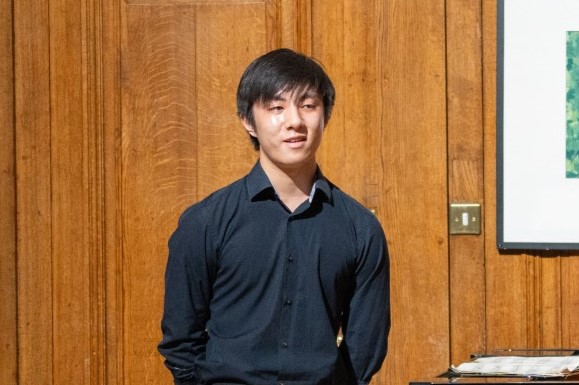
While the exceptional musical talent of Upper Sixth student, Phoenix, is well known throughout Eltham College, fewer among our community will be aware that he is also an accomplished writer and poet.
Drawing on personal experience, heritage and close observation, Phoenix’s work has already gained recognition beyond school. In an impressive new milestone, three poems from his collection Whalestoe Conversations have recently been published across two literary journals: the ‘North of Oxford’ journal, based in Philadelphia, and ‘Writer’s Block’, the literary and arts magazine for the University of Amsterdam.
With support from the English Department and the wider creative writing opportunities at Eltham College, Phoenix has begun to build a strong foundation as a young writer. In the interviews below, he and his teachers share more about the process behind his work and the achievements that have shaped his journey so far.
Interview with Phoenix
Which aspects of your poems or poetry collection do you feel most proud of and why?
I feel that a lot of my poetic inspiration stems from experiences of my upbringing and Asian heritage, and it is that authenticity to my own identity that makes me proud of my poetry. One of the poems that I’m most proud of in the collection is ‘Some things borrowed and blue’, as it’s a nostalgic snapshot of my parents’ wedding that acts as a reflection of their humble adulthoods as first-generation immigrants from China, and how their past continues to influence my present views. Sometimes the poetry that makes me feel most proud is that which allows me to relieve stress and develop my own character during the writing process, an example of which is ‘Sonnet of 4 Months’, which, despite its harsh, venomous tone, actually helped me find forgiveness through a difficult time.
How did you select which poems to submit for publishing?
Whatever feels most personal to me. I think that my poems can usually be categorized as either ‘reflective’ or ‘observational’. My ‘observational’ poems are stream-of-consciousness writings that can be completely based on whatever happens to be on the top of my mind, be it a certain painting, a dream I had, or an antihistamine tablet! However, it is my reflective poems that get me excited and passionate the most. These tend to stem directly from my photographic memory, and since I was brought up in an artistic environment, writing my reflective poems allows me to retell these remembered vignettes in vivid new narratives, letting me relive certain memories whilst embracing the present. Poems that expose emotional tenderness shamelessly have always been my favourite type. I still remember the first poetry collection I ever cried to, which was actually written by my English teacher, and since then, my main objective has always been to share exactly this sort of reflective beauty with the world.
Looking ahead, what are your plans for your writing or creative work?
Who knows? I’m only just beginning, and I don’t think I’ll ever stop writing poetry, considering how much it’s helped my character grow and develop. I’ve recently been thinking about opening doors of my poetry to other artistic areas, perhaps integrating it in either the visual arts or music. But right now, I’m currently Editor-in-Chief for the school’s upcoming literary, lifestyle, and arts magazine ‘ARDOR’, and we plan to release our first issue later this year… so watch this space!
Interview with Mrs Natalie Whittaker
Mrs Whittaker, the department’s very own published poet, has been supporting Phoenix with his writing.
How do you approach mentoring writers or poets and what do you feel are the most important qualities or skills for emerging poets to develop?
The most important skill that an emerging poet can develop is to read other poets! There isn’t much of a shortcut really, if you aren’t reading or thinking about other people’s poetry it will be quite tricky to write your own. Early poems will inevitably be imitations of other writers that you admire, and that’s a good thing – to immerse yourself in someone else’s voice before finding your own. When I was Phoenix’s age my poems were bad imitations of Sylvia Plath, or Elizabeth Bishop, or whoever I was really into at the time. It’s part of the process.
I’d also advise keeping a diary or journal, even if it is just rough notes, to keep in the habit of writing regularly. It’s like exercise. I’ve been teaching an enrichment course on writing poetry to the Lower Sixth this year, and they’ve all been pleasantly surprised by what they can produce if they just get over that initial fear of the blank page.
Are there particular moments or achievements in Phoenix’s journey that stand out to you?
I’m very proud of Phoenix for having some work accepted for publication, and of course his offer of a place to read English at Oxford – his love of poetry was clearly a contributing factor to that. I’ve just really enjoyed chatting to Phoenix about poetry and suggesting books and events to each another. It’s always a pleasure to teach a student who has a passion for your subject.
What advice would you give to new poets about selecting journals or preparing their submissions?
Read journals and magazines to get a sense of where you think your work will fit. The National Poetry Library in the Southbank Centre is a great resource for journals and competitions, and you can browse online or in person. Every publication or competition has slightly different rules regarding layout, line count, simultaneous submissions etc, so read the small print!
In terms of preparing poems for submission, I’d say find peers, a writing group or a mentor to offer editing advice. The best poems are usually the result of a collaborative process to some extent, and thoughtful readers and editors can push your work into different directions or nudge it towards being the best version of itself.
Congratulations to Phoenix on this impressive achievement. We look forward to seeing how his work develops in the years ahead.