Debating Success at the Oxford Schools Competition
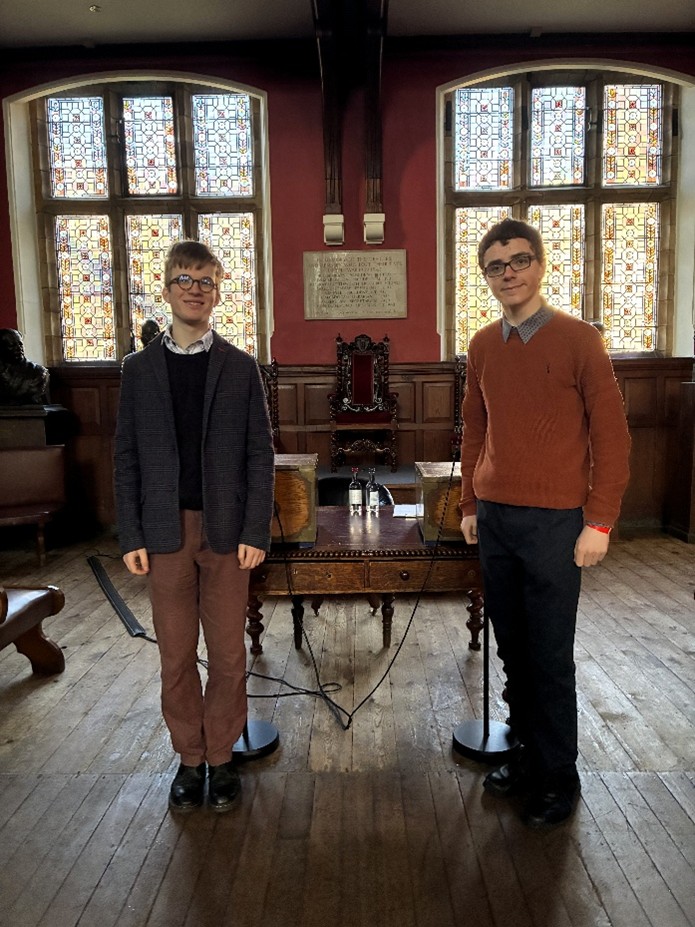
Earlier this term, Eltham College’s debating teams took part in the Oxford Schools Debating London (South) Heat and went on to compete at the National Finals Day in Oxford. In this article Barney and Jonny (Year 11) Share their experiences of the competition, from online rounds to debating in the historic Oxford Union.
Oxford Schools is an annual British Parliamentary debating competition. British Parliamentary debating is distinct from other formats in that there are four teams of two in each debate (two teams on each side). This means that, to win, you must not only prove that your assigned stance is correct but also provide more important, or better-explained, arguments than the other team on your side of the debate.
This year, Eltham entered four teams into the South UK regionals: Oli and Seth, Jonathan and Dylan, May and Alexia, as well as us. The regionals were held online via Zoom, which was a very different experience from traditional in-person events. Thankfully, we managed to avoid any technical difficulties, and the entire heat ran smoothly.
Our first debate was “This House prefers a world without social comparison”, where we were assigned the position of Closing Opposition. We introduced a new perspective by providing historical examples of how social comparison fuels societal change, with a particular focus on the Revolutions of 1848, and we won this debate.
In the second round, the other three Eltham teams were drawn against one another, while we debated the motion “This House believes that celebrity activism has done more harm than good” against three teams from across southern England. As neither of us is particularly well-versed in celebrity culture, we struggled to provide concrete examples to support our claims and finished in second place.
Having ended the heat on five points in total, we were placed highly enough to secure a spot at Finals Day. Unfortunately, the other teams did not break, although all came very close.
About a month later, we were up bright and early to catch the 06:52 from Paddington to Oxford for Finals Day. We were initially addressed in the Oxford Union, an ornate Gothic building constructed in the Victorian era, which famously hosted the “King and Country” debate in the 1930s.
Our first debate was “This House, as an author from a marginalised background, would prefer to write hopeful stories that emphasise resilience and community rather than focusing on oppression and suffering”, where we were Opening Opposition. We based our arguments on the idea that it is stories of suffering that are remembered throughout the ages. Overall, this was a motion that nobody in the room expected, and we began the day with a respectable second place.
Our second motion was the more conventional “This House would ban religious leaders from running for office”, for which we were assigned Opening Government. We were fortunate to have encountered a similar motion at ICYD. We argued that the unquestioned truths associated with religion can impede the proper functioning of democracy and, after a narrow decision, secured another second place.
After a quick lunch, we returned to the Union building for the third motion: “This House believes that the narrative that society has failed boys and young men has done more harm than good”, where we were Closing Government. This was a difficult motion for closing teams, and we finished in fourth place.
As we could no longer break to the open quarter-finals, our final motion gave us the opportunity to try something new. We were Closing Opposition for “This House believes that European political parties should adopt a cordon sanitaire” (a policy whereby parties refuse to form coalitions with extremist parties). This motion played to our strengths, as we both have a strong understanding of European history. We argued that isolating extremist movements can make them more radical and dangerous. We concluded the day with a first place in our final debate.
Overall, it was a brilliant experience. Being in the iconic Union building, listening to round announcements as the busts of Gladstone and Asquith looked on, was unforgettable. We will certainly aim for victory again next year.
Finally, we would like to thank the organisers at the Union for running the event, as well as Mr Cook for all his coaching and for sacrificing a valuable Saturday to accompany us to Oxford.