What is Love?
By Elena
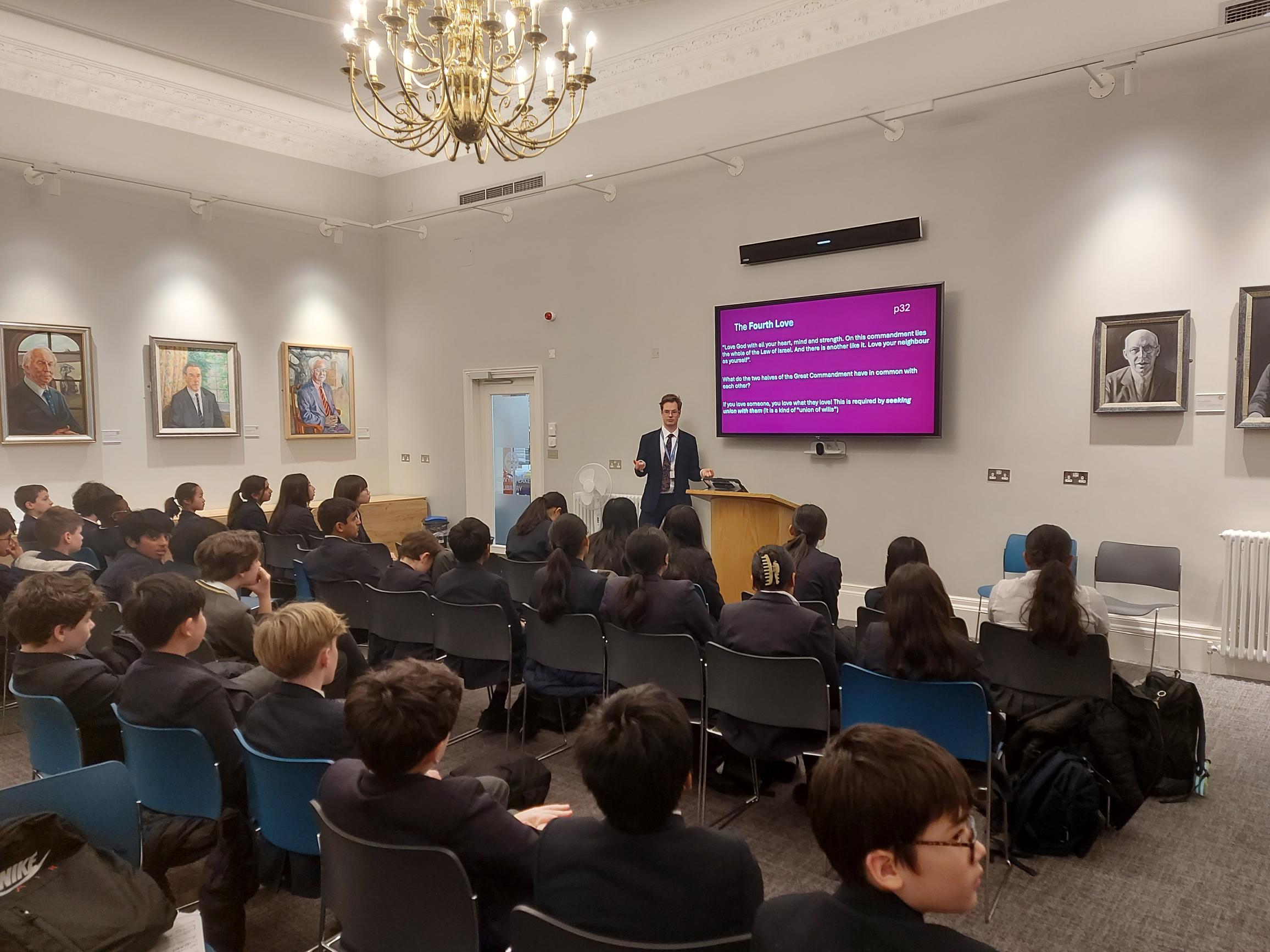
“What is love?” This is a tricky question because there is no ‘set’ way of using the word ‘love’, explained Dr Burling, Head of Philosophy and Theology, to the Year 8 scholars. We define it by looking carefully at the different ways we use the word and applying it in sentences to see if it works. Then we can find what the sentences all have in common. This is called ordinary language analysis and is a major method in 20th-century philosophy. C.S Lewis (a 20th century philosopher and author of The Chronicles of Narnia) wrote a book on love.
In The Four Loves, Lewis argues that there are four different types of love that correspond to four words the ancient Greeks used for the concept:
-
Storge, which translates as affection, is what we feel around people we know well, and explains our love for inanimate objects (like saying, “I love chocolate”).
-
Philia is a different word for love, used when friendships are a true meeting of minds and someone is committed to the same ideals as we are.
-
Eros is the Greek word for romantic love. True “eros” is experienced through devotion to a particular person.
-
Agape is translated into Latin as caritas, which gives us the word charity. It is aimed at all humans and is the good we try to show in everyday life – desiring the good of the other person.
“Love justifies many of our actions,” said Dr Burling. That’s why it is so important to understand what exactly it is.
We went on to look at the views that Thomas Aquinas and Eleonore Stump have expressed about love. Thomas Aquinas was a Dominican friar, theologian and philosopher from 1225-1274 AD and Eleonore Stump is an American Philosopher and the Robert J. Henle Professor of Philosophy at Saint Louis University. Although they have lived hundreds of years apart, their views on love are surprisingly similar:
- Love is a habit of the lover, which is aimed at the beloved.
- This habit guides actions to a) seek union with the beloved and b) seek what’s good for the beloved.
Over time, these habits build until they constitute true ‘love’ for the beloved. If there is an argument between the two people, they will love each other still even though they are mad at each other. However, love can come to an end if they either or both individual has changed too much (such as adopting a vice).
A fitting quote from Shakespeare is that ‘true love cannot be found where it truly does not exist, nor can it be hidden where it truly does.’
We are still figuring out what love is, and everyone has different interpretations of it.