The metamorphosis of Kafka’s The Metamorphosis
by Elena, Year 9
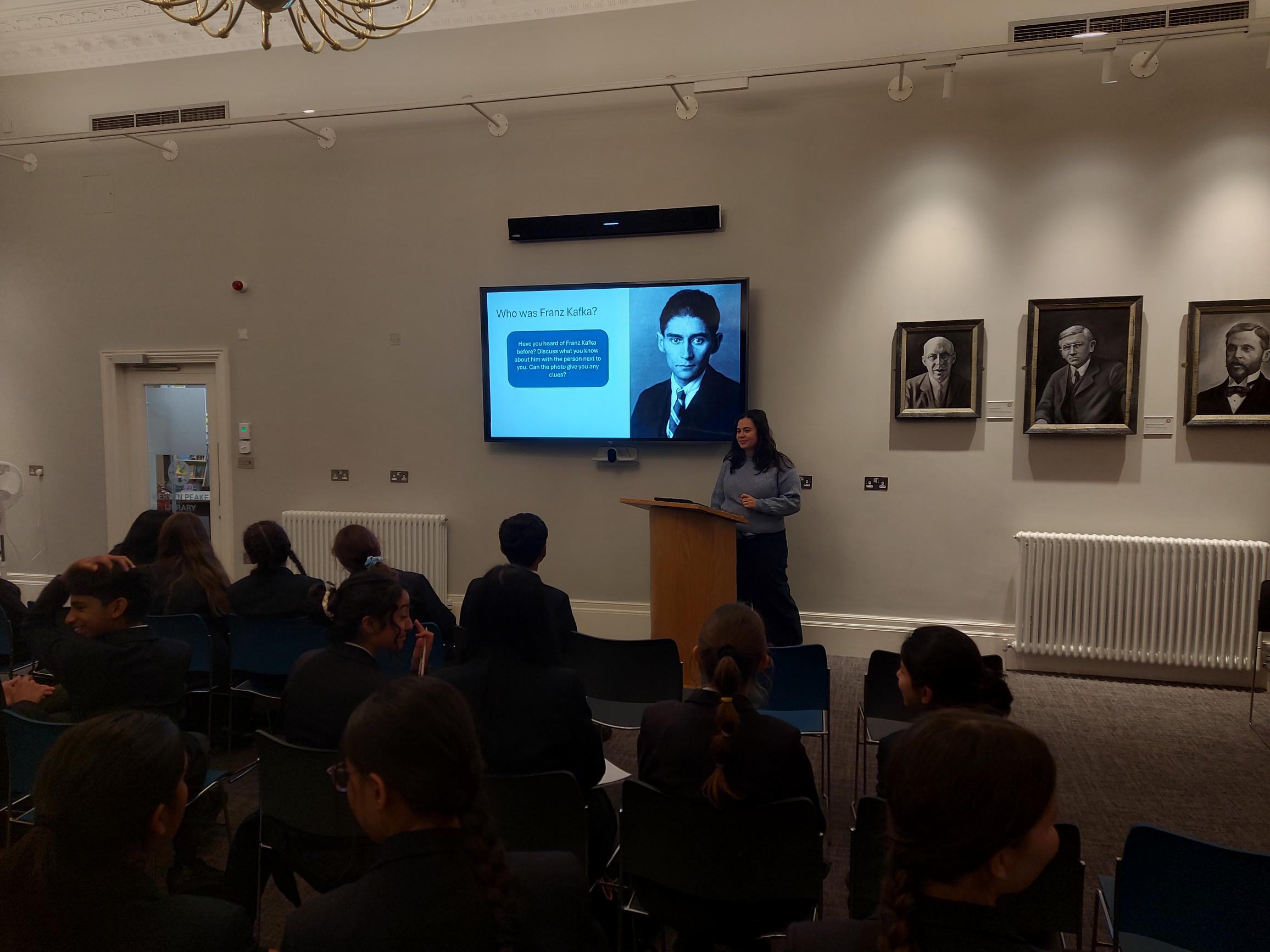
A travelling salesman wakes up to find he has become an insect or, more specifically, an ungeheueres Ungeziefer, a German phrase often translated as “monstrous vermin”. This novel, The Metamorphosis by Franz Kafka, is just seventy pages long, yet is a point of fascination among literary scholars. In a lunchtime talk to Year 9 scholars, teacher of modern languages Ilona Brown presented many different interpretations of the psychological torment experienced by the novel’s unfortunate protagonist Gregor Samsa.
Franz Kafka was a German-speaking modernist writer, born in Prague in 1883 into a middle-class Jewish family. Scholars have argued that Kafka’s main themes of isolation, alienation and identity may have been shaped by the chaos of World War One when he was writing, a time when government bureaucracy and industrialisation of modern society were on the rise. Another idea is that the narrative in which Gregor loses his job, his freedoms, his space, his voice and self-sufficiency must be somewhat autobiographical, reflecting Kafka’s troubled relationship with his authoritarian father. Others have observed that Kafka suffered from tuberculosis, an illness that could have informed Gregor’s decline and eventual death.
Intriguingly, The Metamorphosis and Kafka’s other works may even have found a new audience in Gen Z. “On TikTok, where one might expect light content, the hashtag #Kafka has sparked a real storm, garnering over one billion views,” wrote Joor Ekabouma in nssmagazine in 2024. Kafka may appeal to this generation of digital natives (born between 1997 and 2012) growing up in “a hyperconnected yet paradoxically isolated society”. This “cultural phenomenon” revives the novels of Kafka in an age where the author would have struggled to understand the uproar of social media.
It is truly impressive to still capture audiences over a century after the novel was written. Even the word “Kafkaesque”, meaning something extremely unpleasant and frightening, is still used and understood. Kafka has influenced not only his own generation but also readers of the present and, perhaps, those of the far future too.