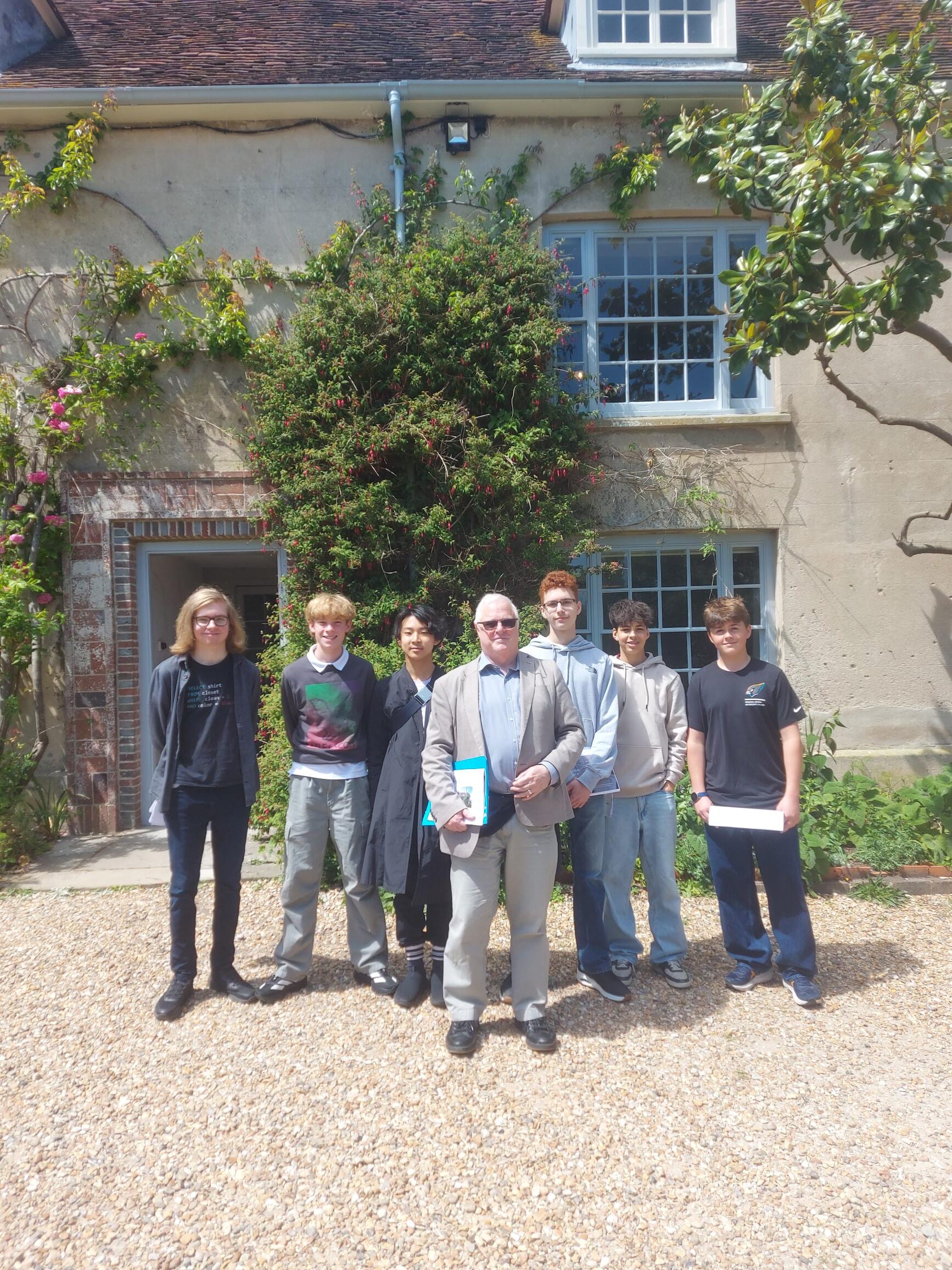
Year 10 Scholars: Art, Ideas, and Everyday Life at Charleston Farmhouse
By Zayd (Year 10)
What do modern art, economics, and feminism all have in common? They all share an address: Charleston Farmhouse — a lived-in workshop where art, literature, design, and conversation were woven into daily practice. Our school trip to Charleston was both fascinating and illuminating, as it allowed us to encounter at close range how the Bloomsbury Group — a community of artists, writers, and intellectuals — tested new ways of thinking about culture, art, and society.
What struck me first, and what left a lasting impression, was the house’s undeniable charm and quaintness. It feels warm and carefully composed, with no two walls alike. Each room carries its own visual rhythm: walls treated as canvases, furniture reshaped by hand, and original artworks integrated into ordinary spaces, blurring any strict boundary between “life” and “art”. Painted surfaces, patterned details, and handmade objects are not merely exhibits; they invite visitors into a conversation. In this setting, ideas were not confined to books or lectures: they were argued over tea, sharpened through friendships, and made visible in the home itself.
Even the garden, redesigned with mosaics, box hedges, gravel paths, and ponds in a Southern European spirit, extends this atmosphere outdoors. It invites reflection on how a society might be arranged differently. Among the Bloomsbury circle was John Maynard Keynes, whose work challenged the assumption that markets naturally return to stability on their own. Instead, he argued that mass unemployment and prolonged economic slumps can persist unless societies take deliberate public action to address them — an approach that reframes economic life around employment, stability, and human welfare as collective priorities rather than accidental outcomes.
Another member, Virginia Woolf, extended this reimagining into the realm of gender and culture. She argued that women’s inequality was not a matter of talent, but of access to education, privacy, and financial independence. Without these conditions, women were systematically prevented from writing, thinking, and creating on equal terms. In doing so, Woolf questioned what must change in everyday life for women’s voices to be fully heard.
Thus, the trip was not only memorable but intellectually stimulating. It made artistic history feel less like a distant timeline and more like a living conversation, still echoing through Charleston Farmhouse’s walls and spaces.