How Many?
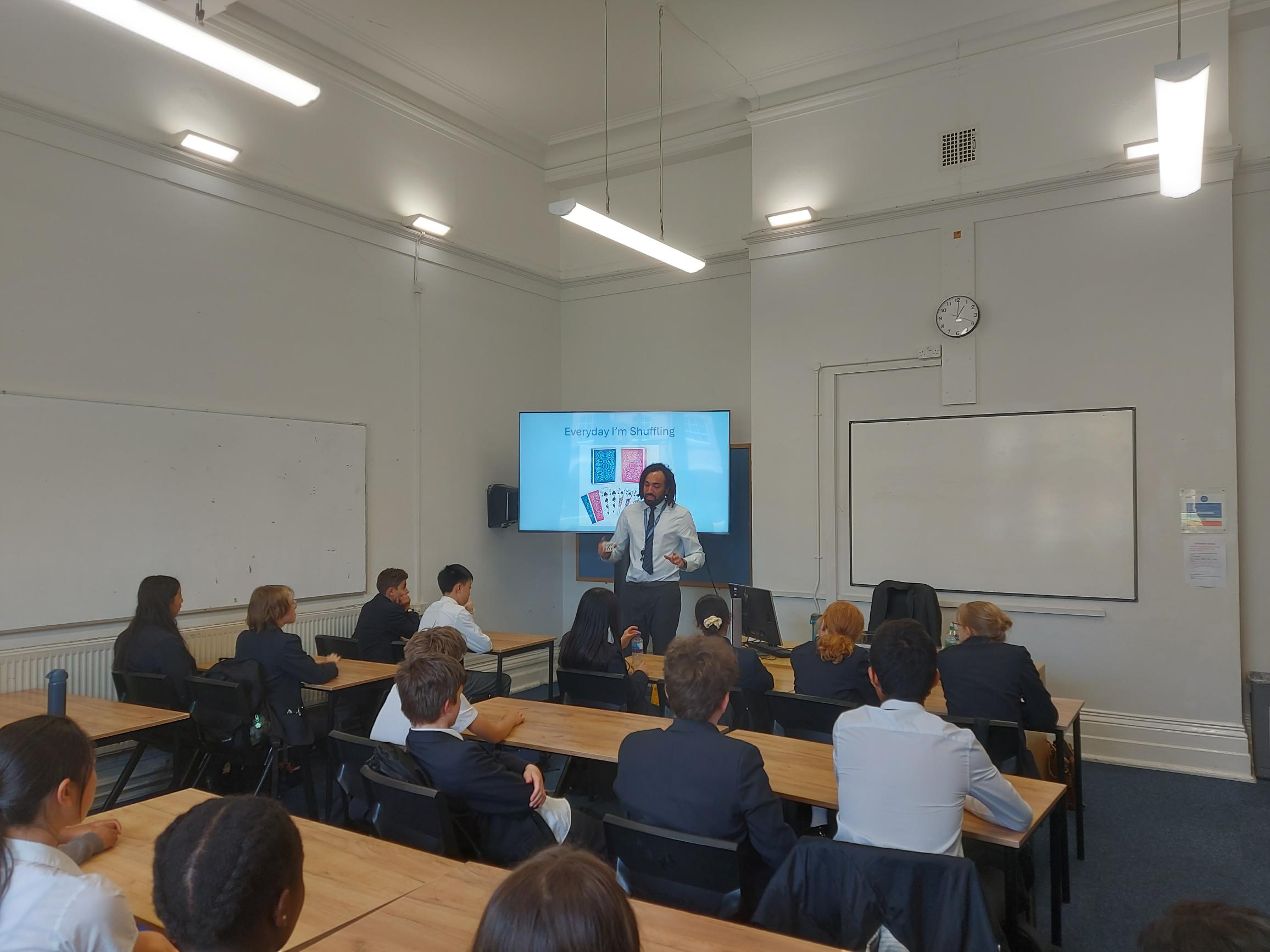
In their last session of the term, the Year 7 Academic Scholars were treated to a fascinating insight into the magnitude of numbers. Mr Astbury-Palmer began by considering a pack of 52 cards, the number of unique different ways the cards might be arranged are 52 factorial. That is 52 X 51 X 50 etc. This number can be represented as -8×10 to the power of 67. Intuitively that sounds pretty big, but by means of a lovely thought experiment Mr Astbury-Palmer showed the students just how big.
Working on the basis of shuffling the pack every one second, how long would it take to work through the options?
Here is a student summary.
“To illustrate the magnitude of 52!, Mr Astbury-Palmer led us on a thought experiment. Assuming it’s possible to shuffle a new combination of cards every second, how much time would we need to have made 52! shuffles? First, we calculated how many shuffles we could complete in a year (60 x 60 x 24 x 365 = 3.1536 x 10^7). Then we were told we were allowed to take a step 2x51x50 forward by 1 metre every 1 billion years. Proceeding in this manner (with one step every 1 billion years and shuffling at a rate of once per second all the while), we worked out that by the time we had circumnavigated the Earth at the equator (a distance of 40.075 x 10^6 m), we would still only have made 1.26 x 10^24 shuffles.
At this point, Mr Astbury-Palmer suggested that for every complete circumnavigation, we would be allowed to remove a single drop of water (0.05 ml) from the Pacific Ocean (a total volume of 710 million cubic kilometres) and were to continue in this manner, one drop at a time after each circumnavigation, until we’d drained it entirely and then instantly refilled it. Then, for every complete emptying and refilling of the Pacific, we would be permitted to place a single sheet of paper 0.1 mm thick on the ground to begin building a tower. By the time the paper stack was tall enough to reach the sun (a distance of 150 billion metres), we would still only have completed 2.68 x 10^64 shuffles. So, this entire sequence would have to be repeated just over 3000 times, still shuffling the deck at a rate of once every second, to have reached our goal of 52! or 8 x 10^67 shuffles.”