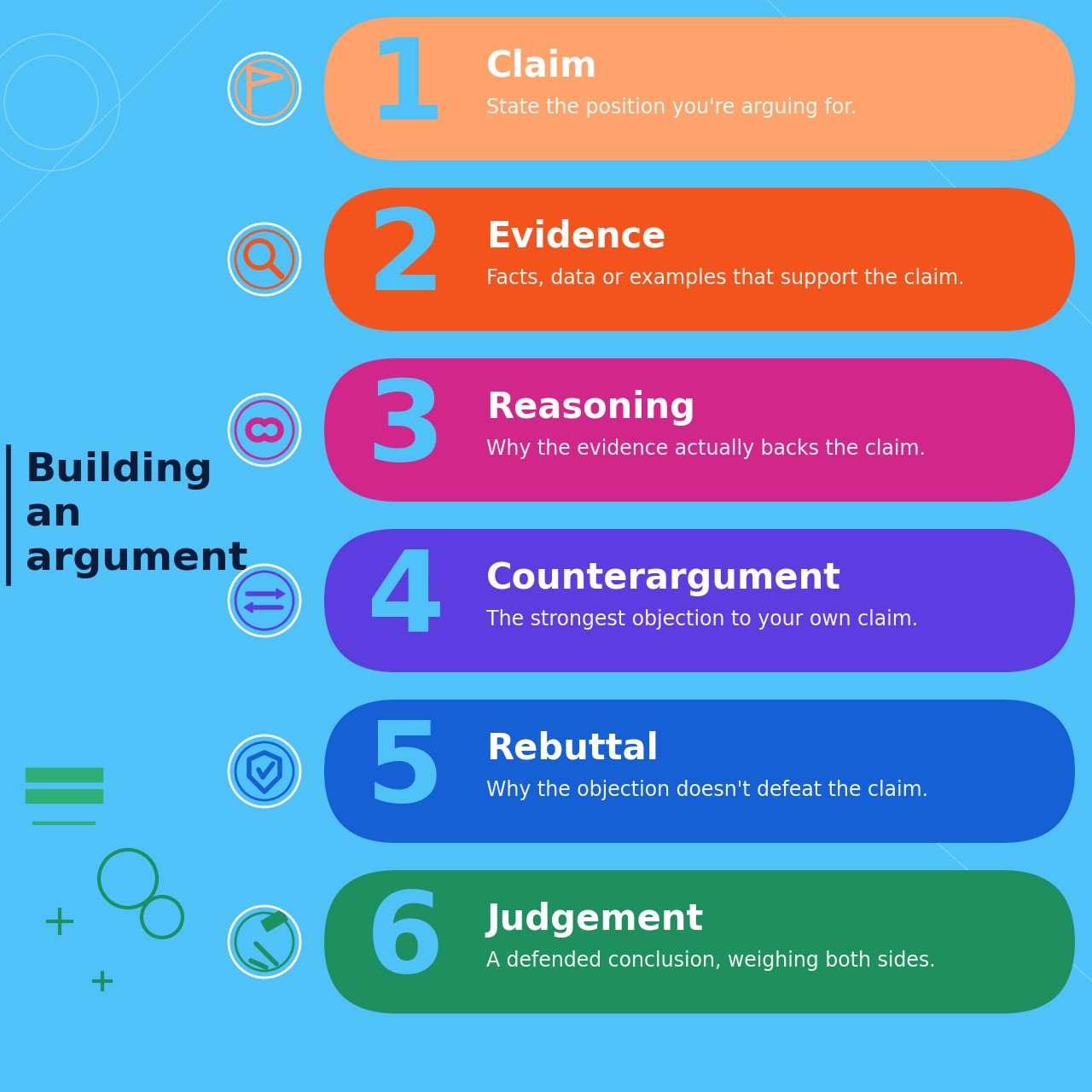
Building an Argument
Mr Cook led the recent session for members of the Year 10 Athenaeum on the theme of argument inspired by Marianne Talbot’s Critical Reasoning: A Romp Through the Foothills of Logic. The purpose of the session was to go beyond a definition confined to the sense that ‘an argument is a disagreement’ towards its logical meaning: ‘a connected series of statements advanced to establish a definite proposition’.
What are the foundations of a good argument? Talbot’s answer is that any argument is built from three parts: a claim (what you are saying), evidence (what backs it up), and reasoning (why the evidence supports the claim). Take away any one of these three and what remains is not an argument, but merely an opinion, description or command.
Two puzzles then framed the session’s central distinction:
- If all the premises of an argument are true, must the conclusion also be true? Deductive arguments answer yes: ‘all mammals are warm-blooded; whales are mammals; therefore, whales are warm-blooded’ allows no possible situation where the premises hold and the conclusion fails.
- If the premises only make a conclusion probable, what should we make of it? Inductive arguments, such as ‘the sun has risen every day; therefore, it will rise tomorrow’, rest on the assumption that the future will resemble the past. Reasonable, but never certain. Much of what we treat as settled, from medical advice to weather forecasts, is inductive rather than deductive in this sense.
The session explored how everyday failures of reasoning are often failures of structure and how the Big Four fallacies: ad hominem, straw man, bandwagon, and slippery slope, all attempt to persuade without engaging the argument’s actual claim. The session’s proposed structure for an argument was the Oxford Formula, a six-step progression from assertion to defended judgement: claim, evidence, reasoning, counterargument, rebuttal, judgement. Students finished the session by testing themselves in a debate carousel on motions from the abolition of homework to the impact of mobile phones in schools.