Year 8 Scholars Explore Westminster
The Year 8 Scholars recently visited Westminster, not only to see Westminster Abbey and the Supreme Court, but also to explore the areas surrounding Parliament, with a particular focus on the many statues found there.
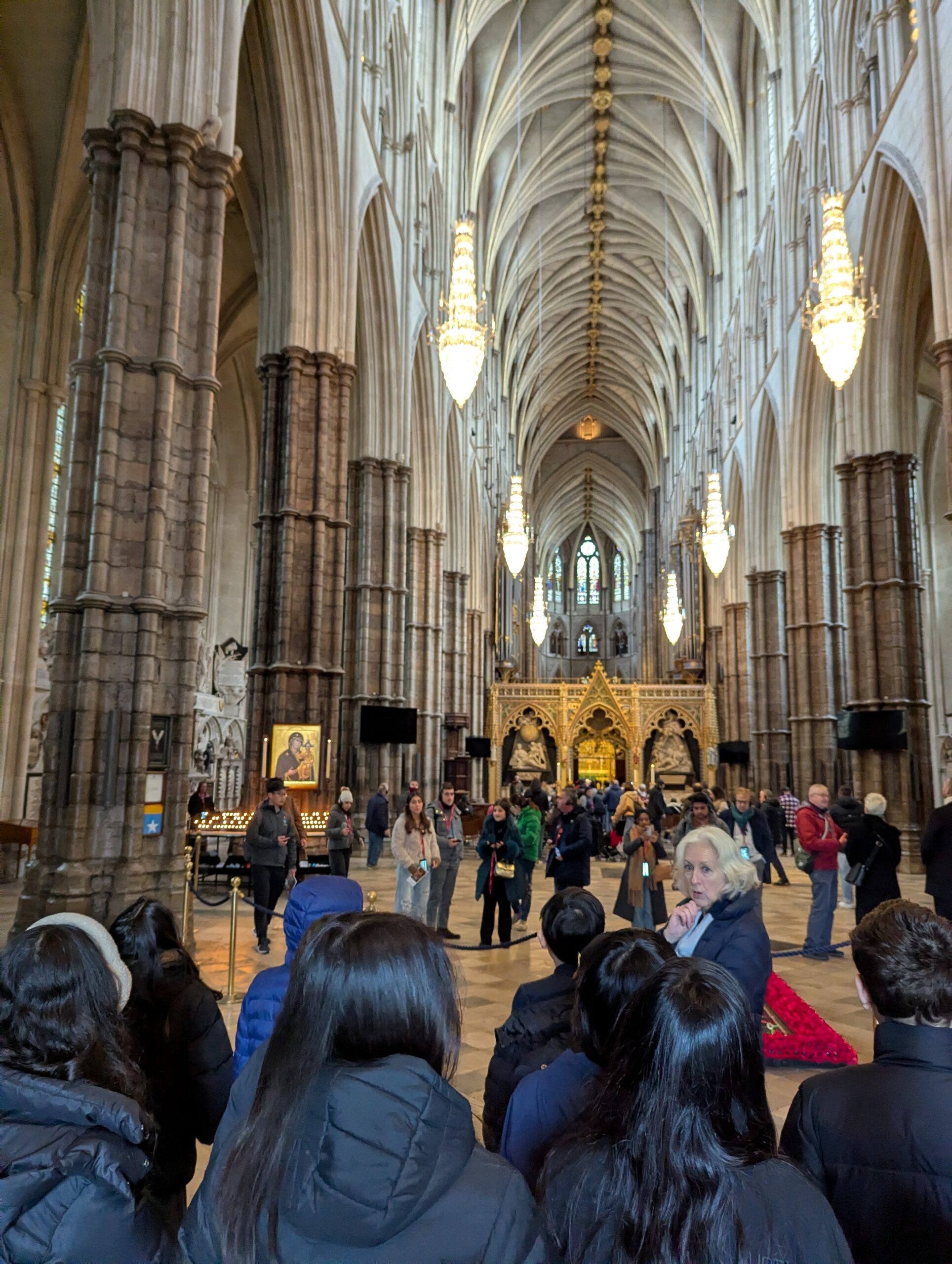
The day began at Westminster Abbey, where, amongst the many fascinating memorials, particular time was spent studying the art and architecture of the building. The students, accompanied by some excellent guides, examined icons, the vaulted roofs, and the Abbey’s most recent addition, a window by David Hockney.
After lunch, the students moved to Parliament Square to explore the statues there. From Winston Churchill to Nelson Mandela, and including various Prime Ministers and other significant figures, such as Millicent Garrett Fawcett, the students were encouraged to consider the design and messages of the statues. They also reflected on the collection as a whole, asking whether any inclusions or exclusions were surprising.
The final stop of the day was the Supreme Court, just across from Parliament Square. The students were able to sit in one of the courtrooms, not in session at that time, and Mrs Powis-Holt spoke about the origins and significance of the Court. There was then a visit to the interactive museum, which illustrated the Court’s work.
In preparation for the visit to the Supreme Court, the group had spent some time considering the role of the Court in more detail—discussed in an article here.
Overall, it was a busy, enjoyable, and informative day.
A Podcast by Evelyn & Elena
A Student’s Perspective
Zara (Year 8)
On a very cold Thursday, the year 8 academic scholars had their eyes opened to the history of Westminster Abbey and the story behind the great London landmark.
We left after registering with form tutors and walked to Mottingham Train Station, then took the train into London.
When we arrived at Westminster Abbey, we were given a talk about the history of the Abbey. Did you know that King Edward the Confessor built the first stone monastery in 1042 and the only record of this building looked like is in the Bayeaux Tapestry? Henry III rebuilt the original Westminster Abbey into a much more gothic style in the 1240s, which remained a medieval monastery until its dissolution by Henry VIII in 1540. In 1550, an Act of Parliament made it a cathedral church and almost every monarch since William the Conqueror has been crowned in the Abbey. We were told about the anointing at coronations and how the Coronation Spoon is the oldest object in the Crown Jewels, many of which were sold or destroyed in the 17th century.
After our talk, we were split into three separate groups and were given tours. We were told about the Abbey’s gothic architecture and garden, where monks would grow the herbs and foods they would need. My group was lucky enough to see the Chapter House, which had very good acoustics, where the daily rules would be read. Did you know the back of the Chapter House has similar architecture to Parliament?
After eating lunch inside, we walked from Westminster Abbey to the cold Parliament Square, where we saw many statutes of famous people. A few of these people are Winston Churchill, Millicent Garrett Fawcett, Gandhi and Nelson Mandela. We filled in worksheets, discussing who these people were and why they had been commemorated with a statue in the political heart of London.
Lastly, we visited the Supreme Court, where we sat in an empty court room while Mrs Powis-Holt explained how a case would work. Many of us enjoyed sitting in the seats of judges and appealing positions while others were sitting in seats of spectators. We then went downstairs to the museum and café before making our way back to the train station and eventually school.
Overall, it was an interesting, educational experience, and, though the weather wasn’t on our side, we definitely had a great time.